







Erowid
 
 
Plants - Drugs Mind - Spirit Freedom - Law Arts - Culture Library  
Path :   librarybooks
Against the drug war but not sure what to do about it?
Join Erowid and help provide the world with accurate information.
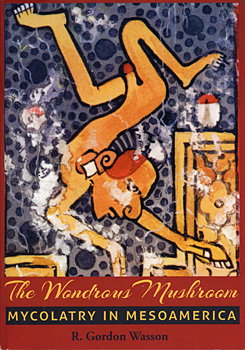
cover image
The Wondrous Mushroom
Mycolatry in Mesoamerica
Rating :
rating
Author(s) :
Pages :
248
Pub Date :
1980
Edition(s) at Erowid :
---(---)
Publisher :
McGraw Hill
ISBN :
007068443X
REVIEWS & COMMENTS #
BACK COVER #
For R. Gordon Wasson's many thousands of devoted readers and students both inside and outside today's community of specialists, this new book by "the acknowledged ranking ethnomycologist," is indeed, as Duke University's renowned Weston La Barre declares, "a considerable event!"

Your enthrallment begins with the book's opening description of the author's all-night vigil at a shamanic mushroom ceremony --the velada-- in Huautla, Mexico. Against this awe-inspiring setting, you embark on a revolutionary investigation and analysis of the meaning and use of the divine hallucinogenic mushroom, Pilocybe mexicana, and its relevance to the cultures and peoples of Mesoamerica from pre-Columbian times to the present.

In its pages you will take part in the sacred ritual, become familiar with its rules and taboos, and witness, as if you were actually present, both the contemporary and historical impact of the sacred mushroom. You will actually experience its deep significance to users for healing, meditation, divination, and religious worship.

Astonishing photographs and drawings accompany Wasson's deep and sensitive penetration into the living and past cultures of Southern Mexico, and the role of the divine plant in the natives' religion, where the Indian happily weds it to Christianity.

A unique work, the book offers a vital key to our understanding not only of pre-Columbian art and literature before it was touched by European and Asian influences but also of the importance of the mushroom throughout the area today. It is the high culmination of Wasson's rich experiences, discoveries, and insights gleaned from a lifetime of voyages into the deepest territories of the hallucinogenic worlds, both past and present. In it he has distilled the sum total of all that he has learned and all he now believes to be the significance of the way people have used sacred drugs --as an element of life, of daily human activity, and as a source of constant and special spiritual strength.

The Wondrous Mushroom will stand as a supreme contribution to anthropological, pharmacological, and art research. Above all, it will remain a human experience not to be missed.

ABOUT THE AUTHOR(S) / EDITOR(S) #
R. Gordon Wasson the preeminent authority on the use of psychoactive mushrooms in the history of such various culture areas as Siberia, India, Greece, and North and Central America, is Honorary Research Fellow with Harvard University's Botanical Museum and Honorary Research Associate with the New York Botanical Garden. The creator and pioneer of the science of ethnomycology, he has written numerous highly lauded books on hallucinogenic mushrooms, including SOMA: Divine Mushroom of Immortality and the recent The Road to Eleusis.

From the beginning, Wasson's interest in the entheogenic ("God-within-us") mushroom has lain solely in their role in Early Man's religious life. During decades of observation and study, Wasson --with his wife-- surmised that mushroom worship prevailed among our remote ancestors in most of Eurasia and the Americas. Then they found proof that mycolatry ("The worship of a mushroom") had indeed also prevailed among peoples on the Arctic Ocean borders reaching all the way to the Bering Strait. And not only there but, as they discovered in the 1950's, among the peoples of Mesoamerica --an area that includes Nicaragua, Guatemala, Western Honduras, El Salvador, Belize, and Mexico east, west, and just north of Mexico City.

According to Dr. Wasson, the psychoactive mushrooms have been overlooked by scholars. He finds them in pre-Conquest mythology and poetry, in pre-Conquest sculpture and mural painting, even in some post-Conquest ecclesiastical art.